
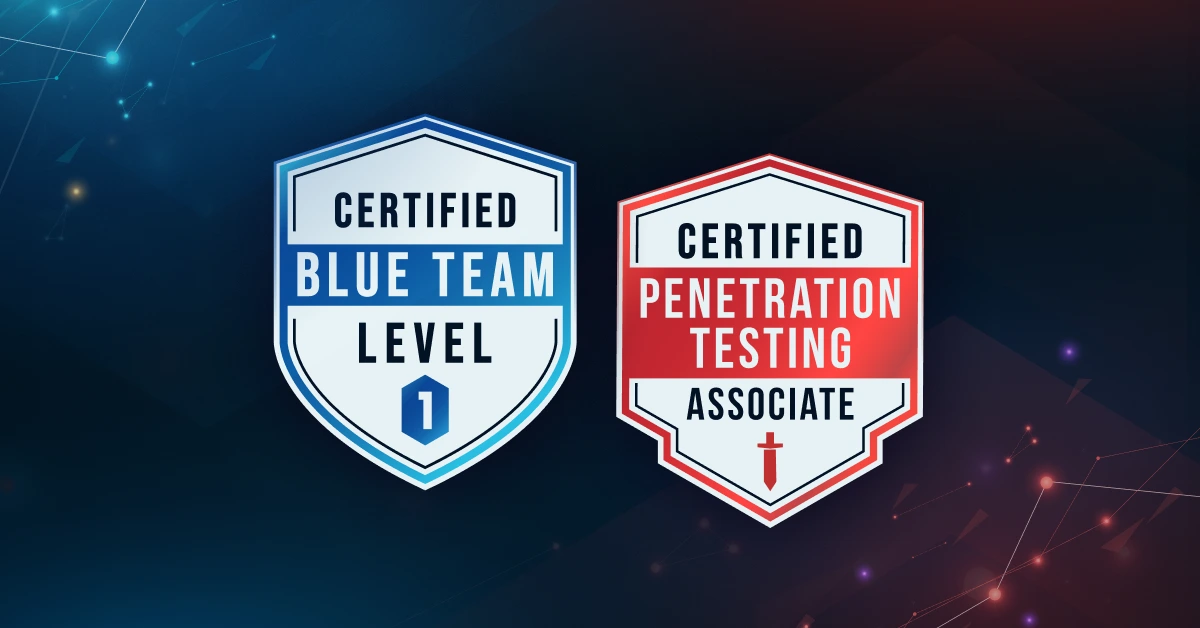
Whether you're taking your first steps into cybersecurity or looking to broaden your technical skills, understanding the differences between certifications can help you choose the one that best fits your goals. BTL1 and CPTA are both practical, hands-on certifications, but they're designed with different goals in mind
The Blue Team Level 1 (BTL1) certification focuses on defensive security operations, while the Certified Penetration Testing Associate (CPTA) develops practical offensive security and penetration testing skills. Both provide hands on, practical cybersecurity training designed to prepare you for real world environments.
Here's how they compare:
BTL1 | CPTA |
| Defensive cybersecurity (Blue Team) | Offensive cybersecurity (Penetration Testing) |
| Ideal for aspiring SOC analysts, incident responders, and detection engineers | Ideal for aspiring penetration testers, ethical hackers, and red teamers |
| Focuses on detecting, investigating, and responding to threats | Focuses on identifying, exploiting, and reporting security vulnerabilities |
| Covers digital forensics, threat hunting, SIEM, and incident response | Covers penetration testing methodology, exploitation, Active Directory, web applications, and cloud security |
| Builds a defender's mindset | Builds a hacker’s mindset |
What is BTL1?
BTL1 is a practical, junior certification focused on defensive cybersecurity. Through realistic labs and investigations, learners develop the skills needed to detect, analyse, and respond to cyber threats in Security Operations Center (SOC) and Blue Team environments.
It's well suited to anyone pursuing a path in security operations, incident response, threat hunting, or digital forensics.
What is CPTA?
CPTA is an junior penetration testing certification that teaches the methodologies, techniques, and mindset used during modern offensive security engagements. Learners gain hands-on experience assessing enterprise infrastructure, web applications, and cloud environments while developing practical exploitation and reporting skills.
It's designed for aspiring penetration testers, ethical hackers, red team operators, and security professionals looking to strengthen their offensive security knowledge.
What are the biggest differences?
BTL1 teaches you to think like a defender. You'll learn how attacks happen, how to detect them, investigate incidents, and strengthen an organization's security posture.
CPTA teaches you to think like an attacker, by adopting a 'hacker mindset'. You'll learn how penetration tests are planned and executed, how vulnerabilities are discovered and validated, and how to communicate findings through professional reporting.
While both certifications emphasize hands-on learning and real-world scenarios, they prepare learners for different responsibilities within cybersecurity.
Which certification should you choose?
Choose BTL1 if you:
- Want to become a SOC analyst or Blue Team professional.
- Enjoy investigating alerts and responding to incidents.
- Want to build skills in threat detection, digital forensics, and incident response.
Choose CPTA if you:
- Want to become a penetration tester or ethical hacker.
- Enjoy understanding how systems can be attacked and secured.
- Want to learn practical offensive security techniques across enterprise, web, and cloud environments to improve your defensive posture.
Can you benefit from both?
Absolutely
Many cybersecurity professionals develop experience in both offensive and defensive security throughout their careers. Understanding how attackers operate helps defenders improve detection and response, while understanding defensive controls helps penetration testers conduct more realistic assessments.
Whether your goal is to defend organizations or uncover weaknesses before attackers do, both certifications provide practical, hands-on learning that can help build a strong cybersecurity foundation.
Ultimately, the right choice depends on your personal goals. If you see yourself investigating threats and protecting organizations, BTL1 is a great choice. If you want to identify vulnerabilities through authorized security testing, CPTA is the ideal starting point.