

What if a routine coding assessment became an attacker’s entry point into your organization?
Attackers use fake job offers and malicious coding assessments to target developers across different companies. By disguising malicious code as a legitimate hiring exercise, they turn a familiar workflow, downloading a project, reviewing its code, and running it, into an opportunity to compromise the developer’s workstation.
The risk is not limited to coding assessments. Compromised third-party packages can also introduce malicious code into otherwise legitimate projects. Both routes exploit the same trust: developers expect the code they install and run to support their work.
But getting that code to run is only the first step. How do attackers deliver additional malware and redirect communications without replacing the program already running on the workstation?
Google Threat Intelligence Group documented one approach in UNC5342’s Ether hiding operation. The North Korea-linked campaign used public blockchain data to deliver malware stages, including the JADESNOW downloader.
Our research explores those delivery mechanisms through a controlled reconstruction, showing how on-chain updates influence endpoint behavior and what evidence defenders can investigate.
Reconstructing Ether hiding: Following the Attack Chain
Our reconstruction draws from the UNC5342 Ether hiding campaign, where an initial JavaScript downloader retrieved JADESNOW from blockchain transaction data. JADESNOW then recovered additional malware stages, including INVISIBLEFERRET, which established communication with attacker-controlled command and control (C2) infrastructure.
https://cloud.google.com/blog/topics/threat-intelligence/dprk-adopts-etherhiding
To demonstrate the technique in a controlled environment, we built a payload preparation tool and a JavaScript loader. The preparation tool encodes the approved demonstration code and prepares it for publication through the smart contract. The loader retrieves updated configuration and encoded content, validates the recovered code against a locally approved hash, and executes it. This allows us to demonstrate on-chain updates without modifying the loader itself.
The demonstration follows six stages, reconstructing the attack chain from a threat actor’s perspective in a controlled research environment.
- Smart contract deployment
- JavaScript loader preparation
- On-chain configuration
- Encoded JavaScript delivery and controlled execution
- command and control (C2) endpoint rotation
- Simulated file collection
These stages demonstrate how threat actors can use blockchain infrastructure to deliver payloads, update instructions, and rotate C2 endpoints without modifying the original loader. From a defensive perspective, the reconstruction highlights opportunities to detect and investigate the resulting endpoint activity.
Stage 1: Deploying the Smart Contract
We started by creating a smart contract using Solidity, a programming language designed for blockchain applications. We compiled the contract in Remix and deployed it to Ethereum Sepolia, a public test network that lets developers experiment without spending real cryptocurrency.
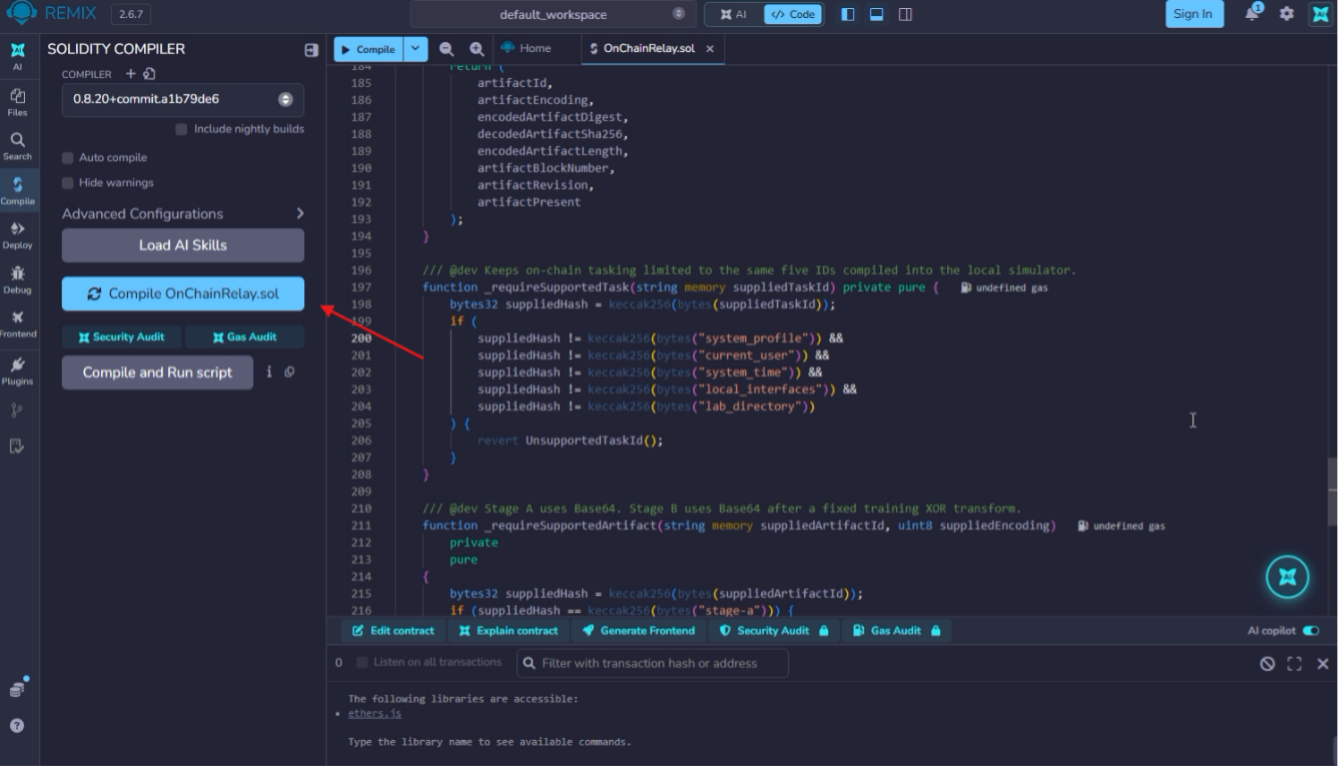
A smart contract is essentially a program stored on a blockchain. It follows predefined instructions and can expose information to applications that know its address.
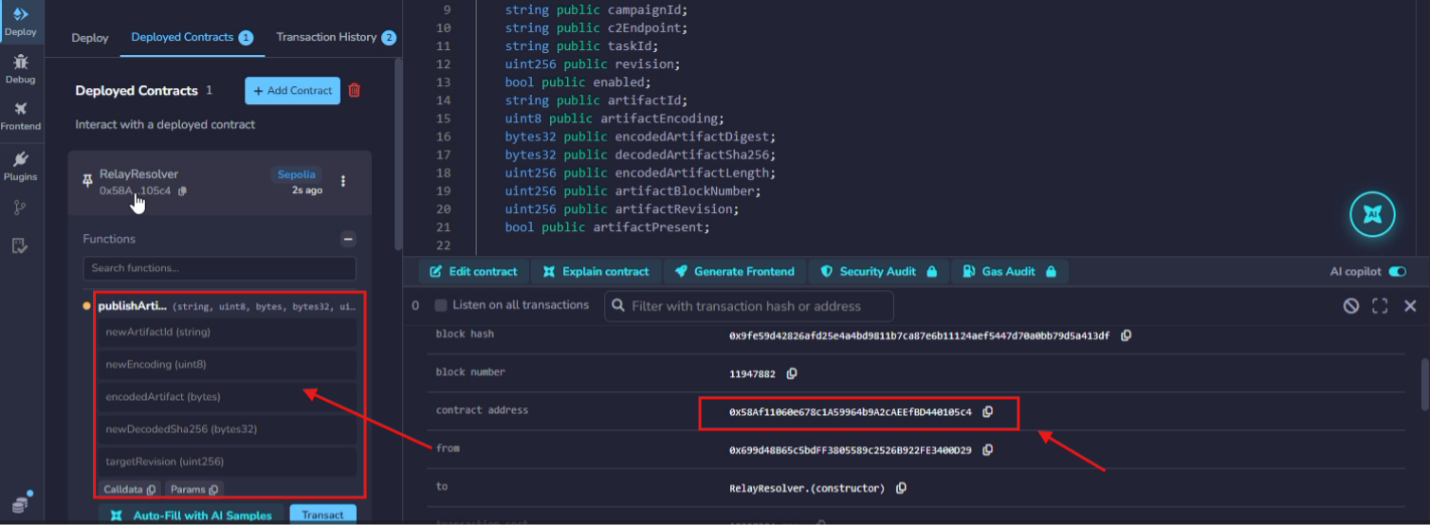
Once deployed, our contract received a unique public address. This address becomes the starting point for our JavaScript loader.
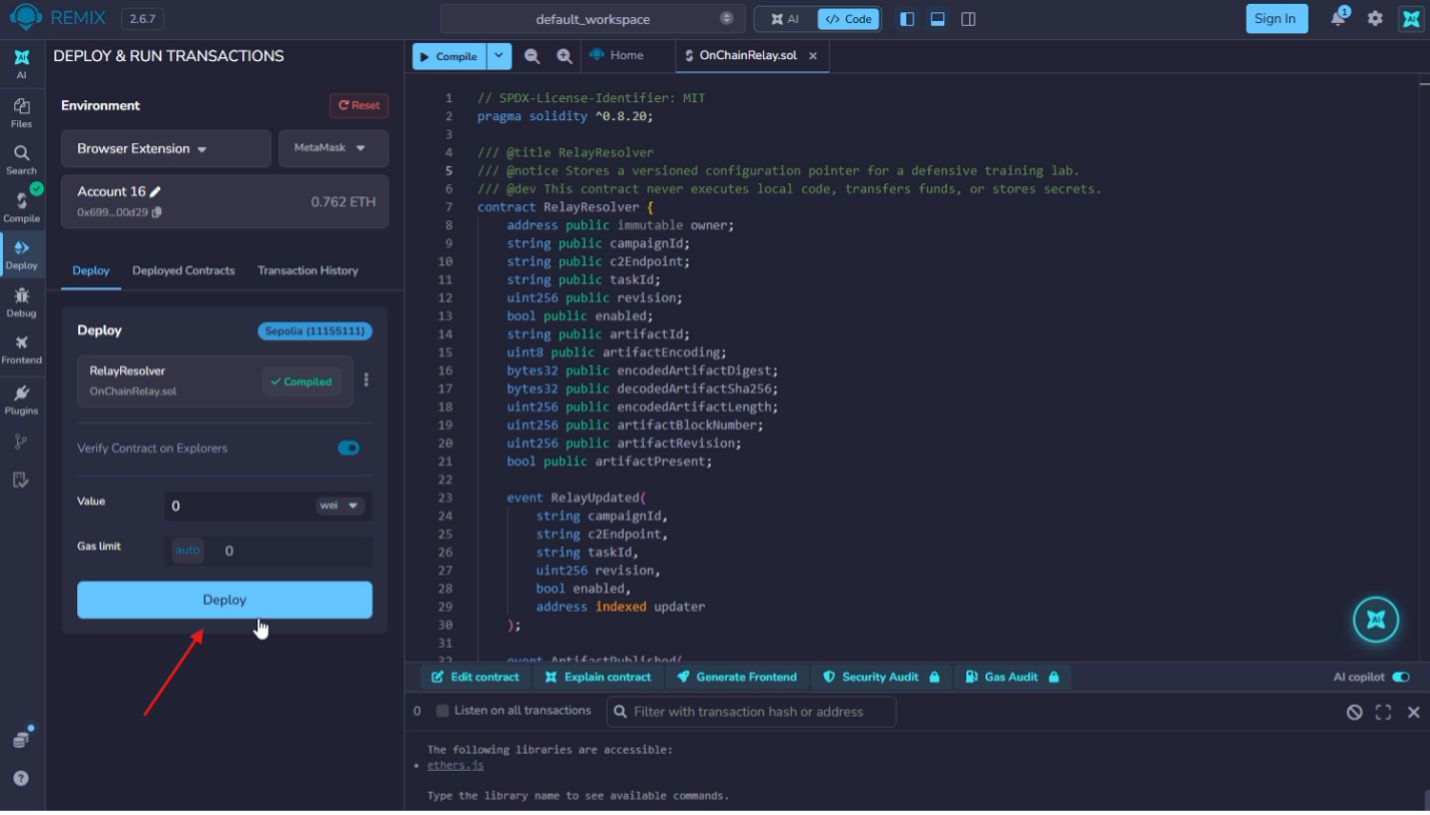
Stage 2: Preparing the JavaScript Loader
With the contract deployed, we prepared the JavaScript loader running on our Windows test machine.
The loader needs two important pieces of information:
- remote procedure call (RPC) URL: The gateway that allows the JavaScript application to communicate with the blockchain network.
- Smart contract address: The specific contract the loader needs to query.
Think of the remote procedure call (RPC) URL as the route into the blockchain network and the contract address as the destination within that network.
Using these values, the loader can read the contract's current configuration without needing a cryptocurrency wallet or private key.

In our reconstruction, the loader also validates the retrieved endpoint against an approved list. The screenshot shows the loader rejecting an endpoint that was not permitted in the local lab.
Stage 3: Publishing Configuration Through the Smart Contract
Next, we used the contract's custom updateRelay() function to publish a new configuration.
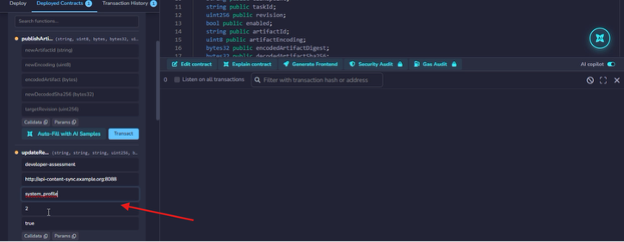
This function allows the contract owner to update several values:
| Parameter | Purpose |
| campaignId | Identifies the simulated campaign |
| c2Endpoint | Specifies the current endpoint |
| taskId | Identifies a predefined local task |
| revision | Tracks the configuration version |
| enabled | Controls whether the configuration is active |
For this stage, we used a fictional developer-assessment campaign, an example endpoint, and the system_profile task.
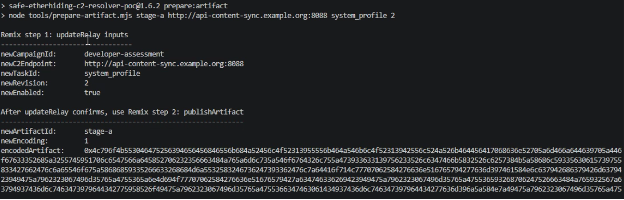
The important part is that updateRelay() changes the information available through the contract. It does not execute commands on the endpoint.
Once the transaction is confirmed, the loader can retrieve the updated values.

This introduces the Dead Drop Resolver concept: a client can repeatedly consult the same public reference to discover updated instructions or infrastructure information.
Stage 4: Publishing and Retrieving an Encoded JavaScript Stage
Configuration retrieval was only the first part of our experiment. We also wanted to demonstrate how blockchain transactions could carry an encoded JavaScript stage.
A local preparation tool generated the encoded stage and its verification metadata.
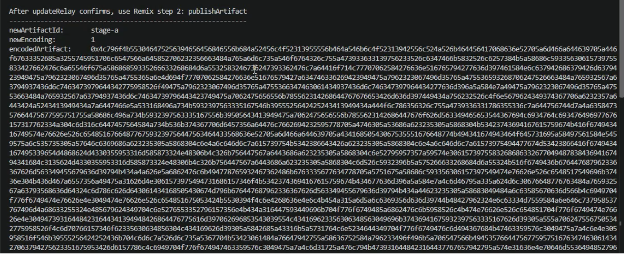
We then used another custom contract function, publishArtifact(), to submit the artifact through a blockchain transaction.
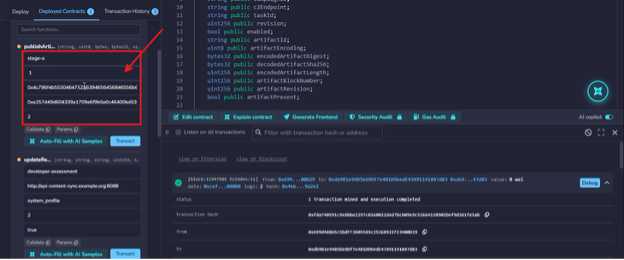
The function accepts information including the artifact identifier, encoding type, encoded bytes, expected SHA-256 digest, and target revision.
The long hexadecimal value visible in the screenshots represents the encoded artifact being submitted as transaction data. The blockchain does not execute it as a command.
When our loader retrieves the artifact, it follows a controlled sequence:
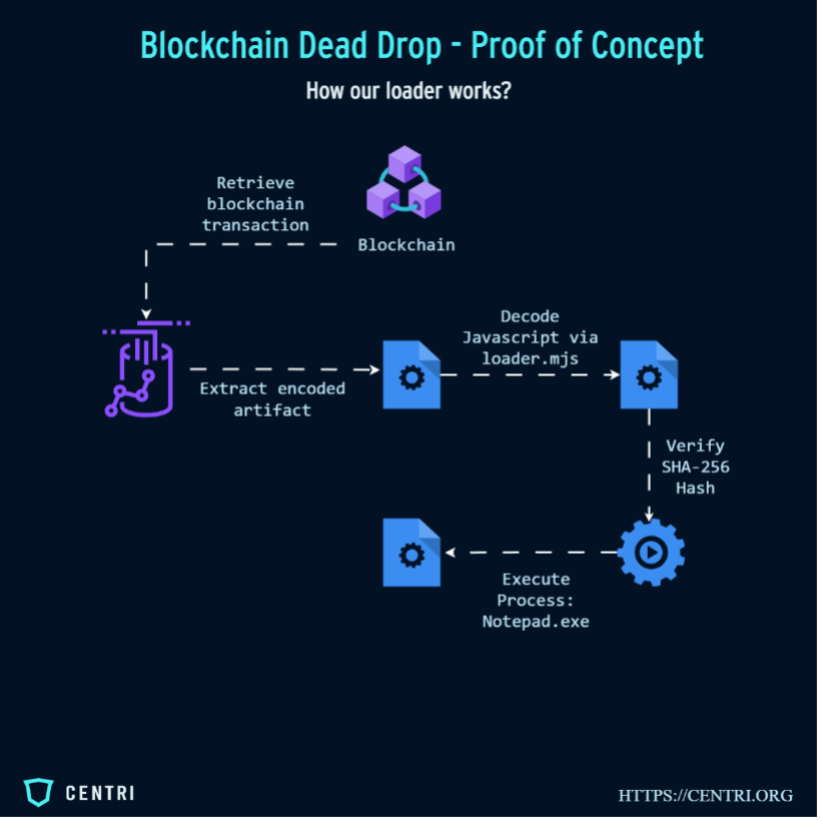
Instead of executing malicious functionality, our demonstration opens Notepad and displays a success message confirming that the recovered stage passed validation.
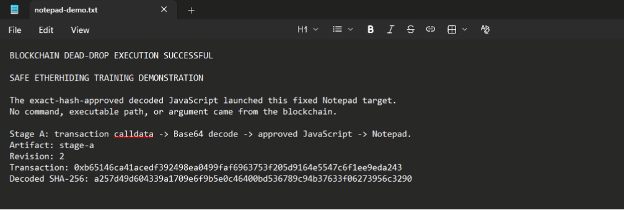
The screenshot also records the artifact identifier, transaction hash, revision, and decoded SHA-256.
This demonstrates how an unchanged loader can retrieve a separately published JavaScript stage. Execution happens on the local computer, not inside the smart contract.
Stage 5: Rotating the command and control (C2) Endpoint Through the Smart Contract
One advantage of a blockchain-based dead-drop resolver is the ability to change infrastructure without modifying the original loader.
To demonstrate this, we used the smart contract's updateRelay() function to publish a new endpoint, change the task to system_time and increase the configuration revision from 2 to 3.
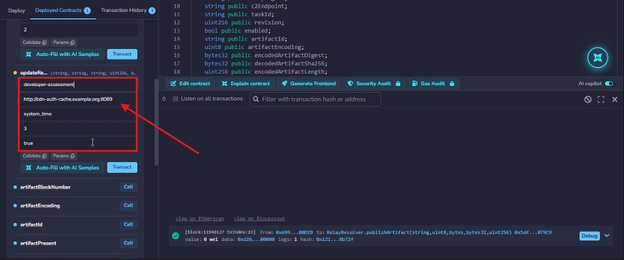
The JavaScript loader continued monitoring the same smart contract address. Once the updated configuration became available, it detected the new revision and retrieved the replacement endpoint.

The console output confirms the transition between revisions, including the rejection of an earlier unauthorized endpoint.
The key takeaway: The loader remained unchanged. Only the information stored on the blockchain changed, demonstrating how threat actors can rotate infrastructure and update tasking without redistributing their original malware.
Stage 6: Simulating Collection Through On-Chain Tasking
We extended the reconstruction to explore how encoded on-chain artifacts could represent actions beyond simple configuration changes.
Using our local artifact builder, we prepared an encoded stage representing a file-collection and archiving operation. The generated artifact and its metadata were intended for publication through the smart contract's publishArtifact() function.
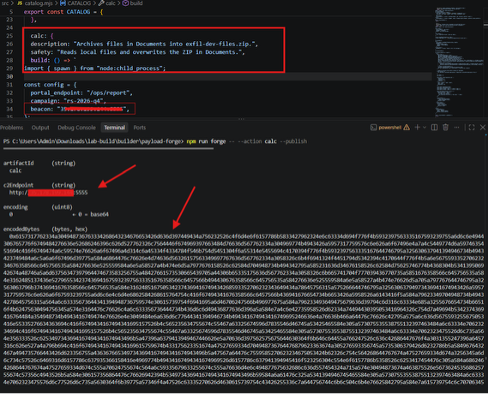
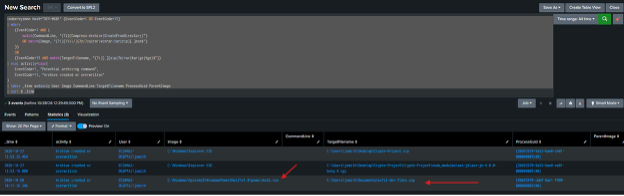
In the corresponding endpoint telemetry, Splunk recorded file-creation events involving ZIP archives, including exfil-dev-files.zip in the user's Documents directory. This provides evidence of local archiving activity consistent with MITRE ATT&CK T1560.001 — Archive via Utility.
What Should Defenders Look For?
Ether hiding challenges traditional IOC-based detection because threat actors can change command and control (C2) addresses and payloads without modifying the original malware. However, the technique still leaves evidence across blockchain, network, and endpoint activity.
Defenders should focus on four areas:
- Blockchain intelligence: Investigate suspicious contract addresses, wallet activity, transaction history, and encoded payloads. Look for infrastructure reused across malware samples or campaigns.
- Network activity: Identify unusual connections to blockchain remote procedure call (RPC) providers and explorer APIs. Where HTTP request content is available, examine contract queries, transaction hashes, and retrieved data.
- Endpoint execution: Correlate blockchain requests with payload decoding, suspicious process execution, and connections to newly discovered command and control (C2) infrastructure.
- Follow-on TTPs: Hunt for reconnaissance, credential access, lateral movement, and file collection occurring after blockchain retrieval.
Detection should remain language-agnostic. Although JADESNOW is written in JavaScript, the same blockchain retrieval mechanism can be implemented in Python, Go, PowerShell, or other languages. What matters is which program accessed the blockchain, what it retrieved, and what it did afterward.
Ether hiding is not exclusive to North Korean threat actors. While this research reconstructs techniques observed in UNC5342's campaign, other adversaries can adopt similar methods. For defenders, understanding the behavior is more valuable than associating a technique with a particular threat actor. Attribution requires supporting evidence, not assumptions.
Useful References and Further Reading:
https://cloud.google.com/blog/topics/threat-intelligence/dprk-adopts-etherhiding
https://guard.io/labs/etherhiding-hiding-web2-malicious-code-in-web3-smart-contracts
https://cloud.google.com/blog/topics/threat-intelligence/unc5142-etherhiding-distribute-malware
https://www.aikido.dev/blog/react-native-aria-attack
https://socket.dev/blog/joyfill-npm-beta-releases-compromised
https://badge.socket.dev/blog/massive-npm-malware-campaign-leverages-ethereum-smart-contracts
