

As many of you have probably noticed, there's been quite a bit of commotion surrounding PHP2Shell since yesterday. If you've lived in a cave during the week and need a bit of a brief timeline on the events, see below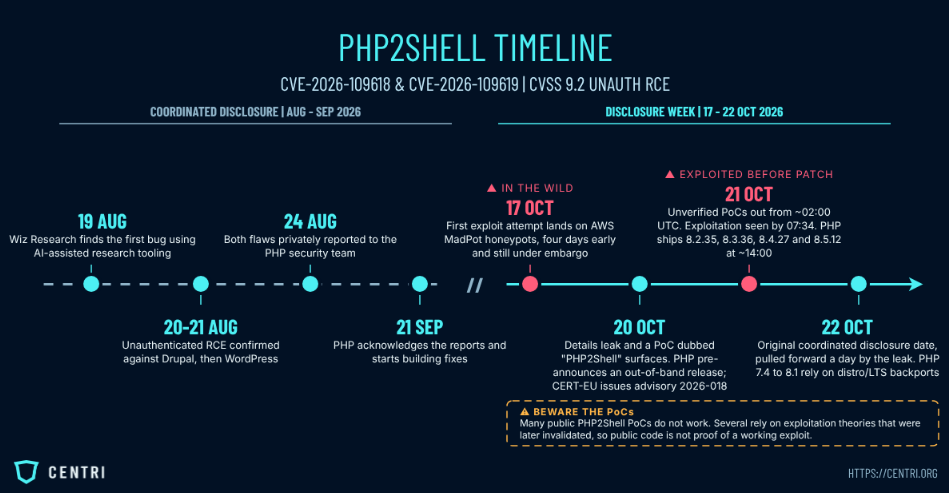
Following my LinkedIn post about the public PoCs I'd found on GitHub, I wanted to share some additional insights after spending a significant amount of time reviewing them. From an attacker's perspective, I didn't find anything particularly impressive.
While that hasn't changed significantly, interest in the vulnerabilities has grown considerably. I've seen numerous scans attempting to identify vulnerable servers, exploit attempts, researchers investigating the issues and developing PoCs, and discussions across various social media platforms. I believe it's still unclear to what extent these vulnerabilities can be exploited to gain repeated access to a production environment, but that's an important consideration in this discussion.
Why? An unauthenticated remote code execution bug in something as ubiquitous as PHP certainly deserves attention. No one should be relying on the perceived difficulty of exploiting such a bug to justify keeping vulnerable systems online
The job of a security leader isn't to predict exactly how the next vulnerability will be exploited. It's to ensure the organisation is prepared when it is. That means knowing what's exposed, having the visibility to identify an attack, and being able to act decisively rather than waiting for certainty.
At the same time, while defense requires taking action against known attacks, defenders also need to distinguish serious threats from noise. Vulnerabilities can be extremely severe, even when they're difficult to weaponize.
Most people are not exploit developers
There are times when a significant vulnerability is disclosed and a PoC appears shortly afterward. However, most cybersecurity professionals are not exploit developers. Turning a crash, patch diff, or vulnerability description into a reliable method of attacking different systems typically requires an enormous amount of specialized expertise. Memory corruption vulnerabilities are a great example.
What people typically see online is a simple representation of an attack, something like:
Vulnerable PHP Server + Malicious Request = Remote Shell.
However, the reality is generally far more complex. Different builds, operating systems, memory layouts, protection mechanisms, extensions, and other factors all influence whether a particular technique will work. Even if someone finds a technique that works in a controlled environment, that doesn't necessarily mean the vulnerability can be easily exploited at scale. This distinction is important when defenders assess the current situation.
Urgency still exists, but so does perspective
Another consideration for security leaders is how AI is changing the time it takes to complete technical tasks.
AI enables people to complete tasks more quickly, including both attackers and defenders.
AI can assist with understanding patches, analyzing crashes, reviewing code, creating test harnesses, analyzing memory, and refining techniques, reducing the time previously needed to complete these tasks manually. This is particularly relevant to vulnerabilities of this nature. Historically, there was often a useful window between vulnerability disclosure and successful mass weaponization, sometimes lasting hours, days, or even weeks. However, as technology advances, particularly AI, we should expect that window to continue shrinking.
We asked Centri's CEO, Josh Beaman, who has years of hands-on cybersecurity experience, for his perspective on how the threat landscape is changing;
One thing you learn quickly in a SOC is that attackers don't necessarily behave differently just because they've found a new way in. The initial exploit might be unfamiliar, but what happens next often isn't. Good detection engineering is about recognizing those behaviours, not waiting for someone to publish a signature or fix for every new CVE.
That doesn’t imply AI somehow enables anyone with average skills to develop exploits quickly. Instead, it implies that those who are technically proficient can accomplish tasks faster than prior to the advent of AI. As such, the added stressors placed upon organisations for managing vulnerabilities will increase accordingly.
If an organisation has an Internet facing service impacted by a serious unauthenticated RCE bug, it is unreasonable to treat said service as simply another item in your patching queue that can wait for the next scheduled maintenance window.
When an attacker is ultimately successful in landing a vulnerability exploit (regardless of complexity), the subsequent steps they perform (after gaining access) will appear remarkably similar to previous actions taken by adversaries.
When an attacker successfully exploits a vulnerability, regardless of its complexity, the actions they take after gaining access will often look remarkably similar to those seen in previous attacks.
This could include:
- Dropping a webshell
- Running commands from the web process
- Downloading tools
- Modifying files
- Establishing persistence
- Making unauthorized outbound connections through the application process
- Attempting to harvest credentials
- Moving laterally through the environment
To be clear, none of this is new or exotic.
Even if you can't find a nice, neat way to detect the initial exploit (especially given the nature of PHP and its interaction with memory), the activity that follows will often involve recognizable attacker behavior. Rather than focusing solely on finding the best "PHP2Shell Detection", defenders should ensure they have robust behavioral monitoring in place.
If your environment can't detect an ongoing attack without a specific IOC, Sigma rule, or exploit signature for that CVE, you're always going to be reacting rather than proactively defending.
The basics still do most of the heavy lifting
Funnily enough, the most effective way to respond to PHP2Shell isn't particularly exciting.Know where PHP is installed.
- Know where PHP is installed
- Identify which systems are exposed to the internet
- Know which versions are affected by the vulnerability
- Patch affected systems
- Ensure appropriate logging is enabled
- Verify that logs are being collected and sent somewhere useful
- Review historical logs for suspicious activity
- Monitor for unexpected activity from web server processes
- Monitor for unusual file changes
- Monitor for unexpected outbound communications from affected systems
- Verify that systems can be isolated quickly if needed
Whether or not the vulnerability ultimately leads to a compromise, it's likely to expose existing weaknesses within an organization:
- Poorly documented or incomplete asset inventories
- Internet-facing services that have been overlooked by management
- Unclear application ownership, leading to poor maintenance
- Inadequate log collection or no meaningful destination for collected logs
- Emergency change procedures that take too long to execute
- Incident response plans that exist only on paper and have never been tested
As Centri CEO Joshua Beaman points out, these weaknesses can have serious consequences when an incident occurs:
Having been on the incident response side of the table, I know how quickly a manageable security event can become a serious incident when nobody knows who owns a system, who can authorize containment, or where to find the evidence. Those aren't technical problems. They're organizational readiness problems, and they need solving long before an attacker arrives.
Its Friday, so check your on-call schedule
In addition to the operational considerations discussed above, there's another practical consideration for security leaders and incident managers. With the situation still evolving, it's important to be prepared for what might happen next:
- We don't yet know where this story is headed over the coming weeks
- More reliable exploitation methods may be discovered by researchers
- Attackers may find easier ways to exploit these vulnerabilities
- Evidence of successful compromises may begin to emerge
Uncertainty is expected, and security leaders and incident managers should plan for it. No one needs to cancel their weekend because a bug has an interesting name, but this would be a good time for security teams to check a few basics:
- Who is on call?
- Who owns the affected systems?
- Who can authorize emergency changes?
- Who can isolate hosts?
- Who is responsible for collecting logs?
- Who is responsible for declaring an incident?
- How does escalation work at 2am?
- Are all contact numbers up to date?
- Does everyone know where to find the incident response plan?
All of these are completely mundane questions until the moment they become critically important. The worst time for an organization to discover that its incident response process only works between 9am and 5pm is when an incident occurs at 10am on a Saturday.
My closing thoughts - Cyber readiness is capability-based
I like to think of cyber readiness as an organization's ability to act when information is incomplete. It's about making decisions based on imperfect data, getting the right people in place quickly, and applying patches without 72-hour internal debates. It's having people who know what to do when a problem arises unexpectedly, even at 2 am on a Sunday.
These capabilities can't be developed in the middle of an incident. They need to be established through planning, team exercises, and regular testing of processes. It's about making sure the fundamentals of your incident response processes work as intended, long before you need them.
This CVE is serious, but your organization should already have the plans, processes, and capabilities in place to respond to something this significant.